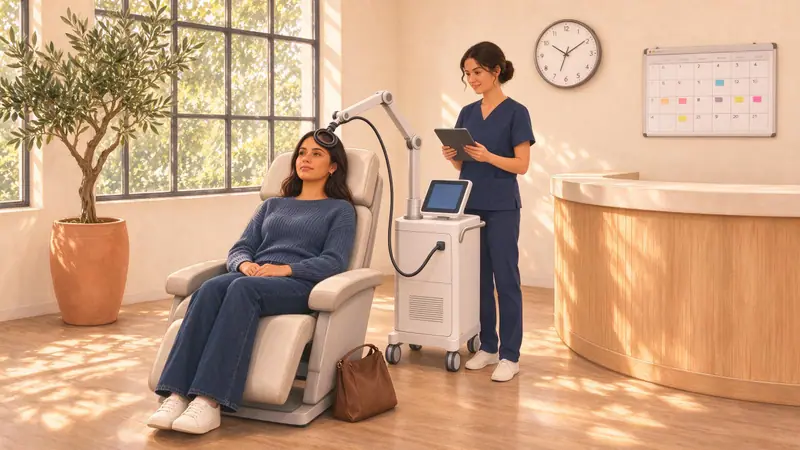
Yes. Traditional Medicare covers TMS for major depression under Part B. The rules come from a local coverage determination (LCD) set by your state's Medicare contractor, and all seven contractors have one. Expect to need a depression diagnosis, one or two failed antidepressant trials, usually a trial of talk therapy, and a psychiatrist's order.
What the Medicare rules usually ask for
The seven policies overlap a lot, but the details differ. These are the points that decide most approvals.
- A diagnosis of major depressive disorder, single or recurrent episode. Most policies say "severe". The Wellpoint Federal policy does not.
- Failed antidepressants. Novitas and First Coast ask for at least one failed or poorly tolerated trial at an adequate dose and length. Noridian, WPS, Wellpoint Federal and Palmetto ask for no response to drugs from two different classes in the current episode, or side effects from two trials. CGS is stricter: less than a 50% drop in symptoms after at least 6 weeks on each of two drugs, or intolerance to four trials. A past response to TMS, or current ECT, also qualifies under most of these policies.
- A trial of evidence-based talk therapy without enough improvement, measured on a standard depression scale. Every contractor except Novitas and First Coast lists this.
- An order from a psychiatrist who has examined you. Wellpoint Federal also accepts other physicians experienced in TMS, and nurse practitioners or physician assistants where state law allows.
Course length is capped too. Novitas and First Coast cover up to six weeks. Noridian, WPS and CGS billing guidance allows 20 sessions over 4 weeks plus 5 tapering sessions. If you have improved by at least 25%, you can have 2 more weeks plus 6 tapering sessions.
Noridian, WPS, Wellpoint Federal and CGS all say scheduled maintenance TMS is not covered. Noridian, WPS and Wellpoint Federal do allow a new course after a relapse if your first course improved your symptoms by more than 50%.
Which Medicare contractor covers your state
| LCD | Contractor | States |
|---|---|---|
| L34998 | Novitas Solutions | AR, CO, DE, DC, LA, MD, MS, NJ, NM, OK, PA, TX |
| L34522 | First Coast Service Options | FL |
| L37086 | Noridian Healthcare Solutions | AK, AZ, CA, HI, ID, MT, NV, ND, OR, SD, UT, WA, WY |
| L34641 | WPS | IN, IA, KS, MI, MO, NE |
| L33398 | Wellpoint Federal (formerly National Government Services) | CT, IL, ME, MA, MN, NH, NY, RI, VT, WI |
| L36469 | CGS Administrators | KY, OH |
| L34869 | Palmetto GBA | AL, GA, NC, SC, TN, VA, WV |
Palmetto GBA is the only contractor that also covers TMS for OCD. You must not have responded to two medications tried for at least 8 weeks. You also need at least 8 weeks of evidence-based therapy that did not help enough. The clinic also has to use an FDA-cleared OCD system. Novitas, First Coast, Wellpoint Federal and CGS say TMS for OCD is not covered.
Medicare Advantage and what you pay
Since 2024, Medicare Advantage plans have had to follow the same national and local coverage rules as traditional Medicare. In practice that means an Advantage plan covers TMS for depression at least as broadly as the LCD for your area. Most still require prior authorization, and many limit you to in-network clinics, so ask the plan before you book.
Under traditional Medicare, Part B usually pays 80% of the approved amount once you have met your deductible, and you pay the other 20%. A Medigap policy may cover some or all of that share.
Full Medicare TMS guide
Billing codes, prior authorization steps and how to find a clinic that accepts Medicare.
Read the Medicare guideSources
- CMS Medicare Coverage Database: LCD L34998 (Novitas)
- CMS Medicare Coverage Database: LCD L34522 (First Coast)
- CMS Medicare Coverage Database: LCD L37086 (Noridian)
- CMS Medicare Coverage Database: LCD L34641 (WPS)
- CMS Medicare Coverage Database: LCD L33398 (Wellpoint Federal)
- CMS Medicare Coverage Database: LCD L36469 (CGS)
- CMS Medicare Coverage Database: LCD L34869 (Palmetto GBA)
- CMS: Who are the MACs
- CMS fact sheet: 2024 Medicare Advantage and Part D final rule (CMS-4201-F)